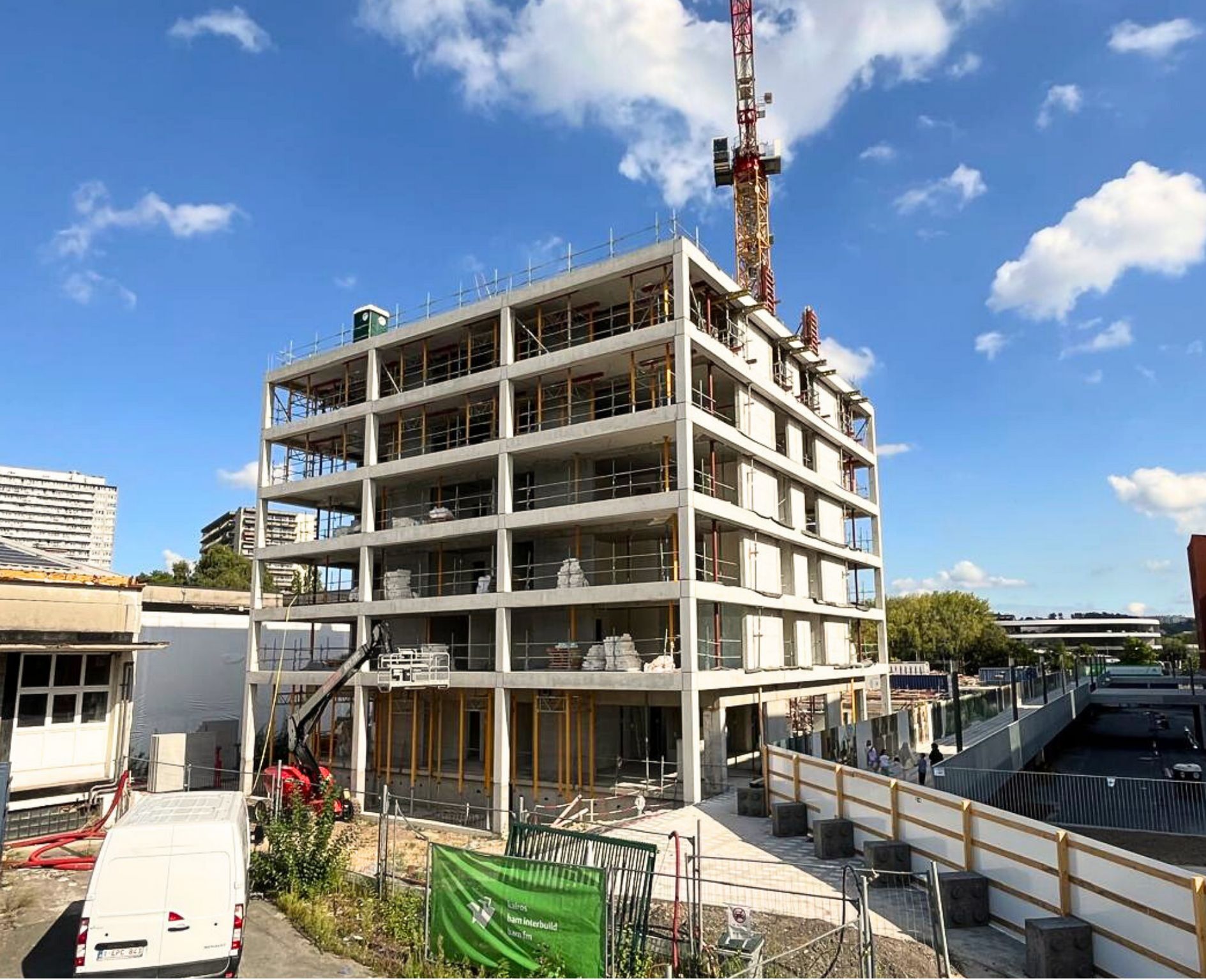
The works for the realization of the new reception building of the Rubens House started on April 19, 2022. Following the preparatory works at Hopland 13, Interbuild will begin work on the design by Robbrecht and Daem architects. During the first phase - from April 19 to June 10 - the site zone temporarily extends into the public domain and there will be disruption on and around Hopland. On some days, the traffic situation will be disrupted.
Construction of the Rubens House's new reception building will begin April 19 and take two years to complete. It is scheduled to open in the spring of 2024. With this reception building, the Rubens House will have the necessary visitor facilities, an experience center, a library with reading room, a museum shop and back office functions. For the past two months, the site has been prepared. After the site area was installed, the necessary demolition work was carried out: the Hopland blind wall and remnants of the pergola were demolished. Afterwards, the site was prepared for the actual construction.
Temporary work zone on public property
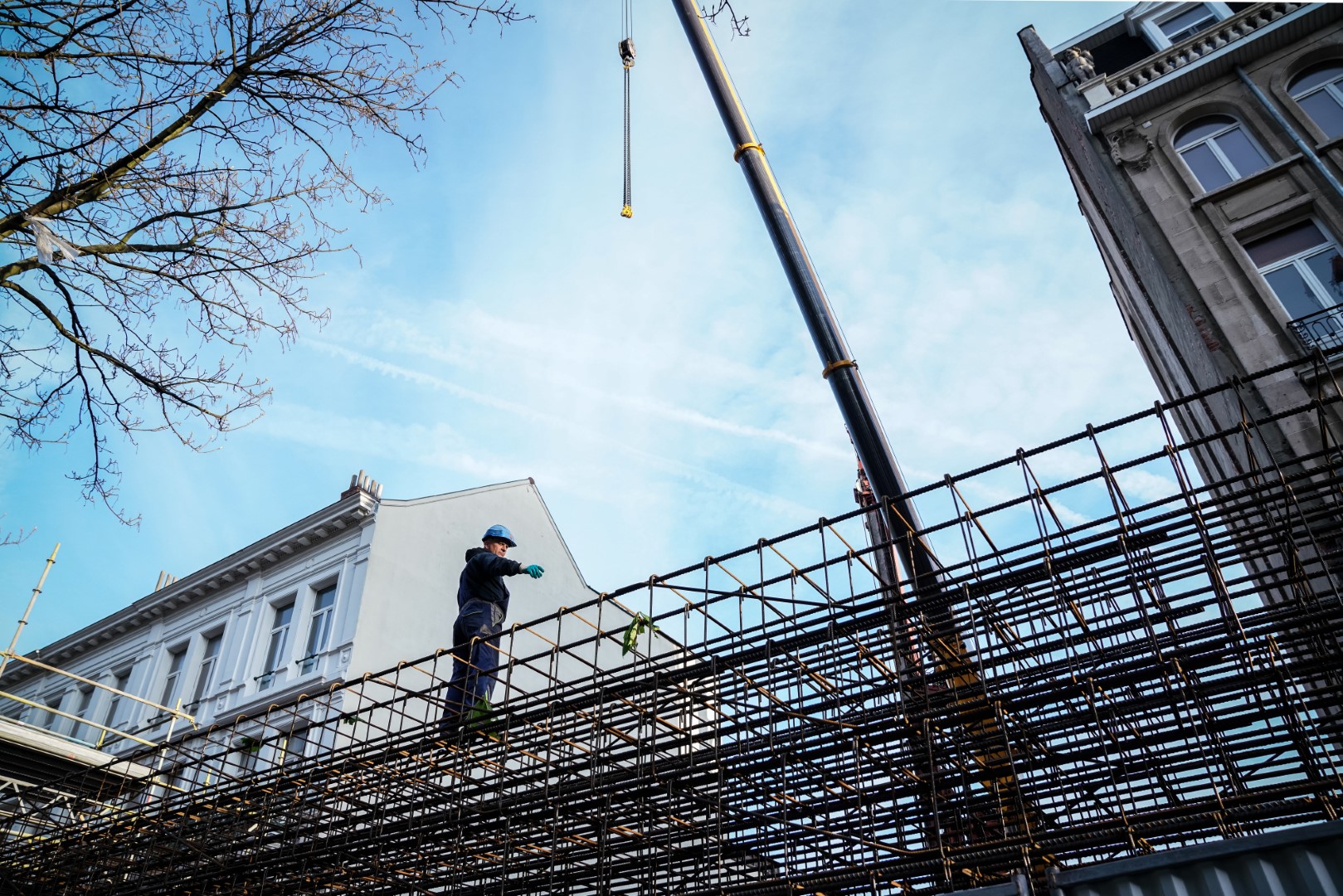
The first phase of work from April 19 to June 10 is also the most intensive. For the shoring up of the basement floors, the site area will be temporarily extended to include the loading and unloading area of May Street for the placement of meter-high silos, containers, a pump and a mixer. There, the cement mixture is created and supplied to the site via a high-pressure pipeline and a temporary overhead gantry above Hopland. A 30-meter-long drilling arm sprays this mixture 28 meters deep into the ground down to the clay layer. This innovative technique creates a watertight tub formed by the shoring walls and the Boom clay layer. Thus, the groundwater table within the pit is lowered and the basement can be built, without adversely affecting surrounding gardens and parks within a one-kilometer radius. Moreover, any contamination in the subsoil can no longer be moved. About five trucks will dispose of the excess silt in the morning, which is created when the shoring walls are made.
Delivery of exceptional construction material causes traffic disruption
The bringing in of the meters-high silos and the hoisting of the exceptionally long drilling arm into the city center have been meticulously prepared and are proceeding with exceptional procedures. For this purpose, Hopland will be closed to all traffic on Tuesday, April 19, between 9 a.m. and noon, and on Wednesday, April 20, between 5 a.m. and 8 a.m. Deliveries to commercial and hospitality businesses on Hopland (between Kolveniersstraat and Wapper), and on Kolveniersstraat via Meistraat will not be possible on those days. Merchants and residents will find all the information at www.rubenshuis.be/vernieuwt and can register via the digital newsletter "Neighbor of Rubens. On May 16 and June 10, Hopland will again be temporarily closed for certain hours. Afterwards, the temporary work zone on May Street will disappear.
Hopland 13 in figures
The building to a design by Robbrecht and Daem architects refers to the rich building traditions of Italian palazzos. The facade will be composed of horizontal lines and vertical cylindrical elements. This creates a uniform whole between the new facades, which in turn interfere with the facade of the Rubens House. The use of circular elements creates a fascinating lighting effect in the building, both during the day and at dusk and night. The two monumental spiral staircases refer to the dynamic imagery of Rubens.
Some figures
- 4,000m³ of soil to be excavated
- 28 meters deep are the foundations
- 10 meters deep is the basement
- 1,400m³ in-situ concrete; approx. 9m³ per concrete mixer
- 350 tons of reinforcing steel, of which 200 tons are to be braided on site and 150 tons in precast concrete elements
- 20 geothermal drillings at a depth of 150m
- 456 cylindrical elements; these round columns in architectural concrete are placed against the front and back facade. They have a diameter of 18cm and are 420cm high on the ground floor and 340cm high on the floors
- 800m² of glass, divided between the front and rear facades
- 48 solar panels
- 700 liters of paint for painting
Design and implementation
- Client: city of Antwerp for Rubens House
- Builder: AGVespa
- Design team Robbrecht and Daem architects
- Engineer stability : Bureau d'étude Greisch
- Engineering techniques: hp engineers
- Acoustics & building physics engineer: Daidalos Peutz
- Heritage architect : Callebaut architects
- Contractor: BAM Interbuild
- Safety coordinator: EVEKA bv
- Grantees: city of Antwerp & Tourism Flanders
Alderman for Culture Nabilla Ait Daoud responded with particular enthusiasm:"For quite some time we have been preparing the future of the Rubens House. Now the concrete realization begins. With the new reception building, past and future come together on one site here. Without shortchanging one or the other. That requires vision and imagination. Peter Paul Rubens did that 400 years ago when he flamboyantly connected an existing house in Flemish style with a new, stunning architecture inspired by Italy. Robbrecht and Daem probe that balance just as ingeniously with this design. I am very much looking forward to the final result."
Flemish Minister of Tourism Zuhal Demir shares this enthusiasm:"Big plans require big works: in the coming years, we will breathe new life into Rubens' biotope in Antwerp. Thanks to 21st-century technology, visitors will soon be catapulted back 400 years to 17th-century Antwerp. From 2024, the experience center will be a starting point for the further discovery of Rubens in the city. Once the works in the museum itself are completed in 2027, young and old will be able to meet Rubens through the experience center, the living and working quarters in the historic house and the newly laid out Rubens garden. After all, to really know the Flemish masters, you have to travel to the place where they lived, worked and lived."